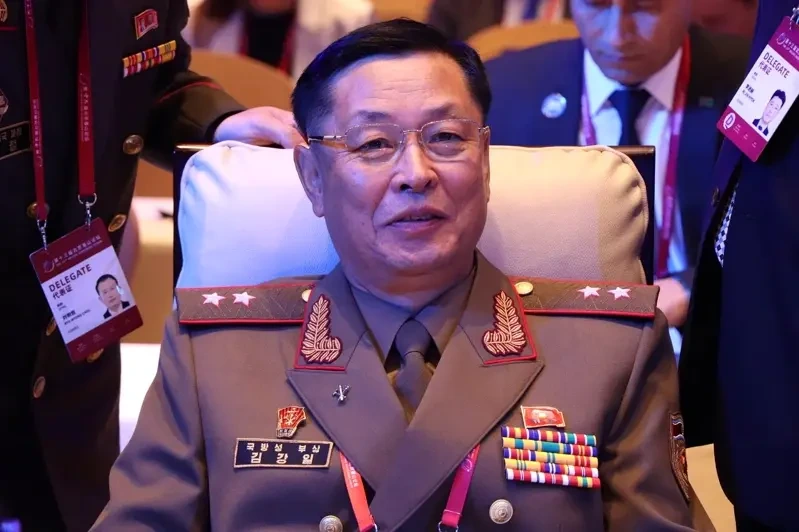
Amidst international attention regarding the potential resumption of dialogue between the U.S. and North Korea—and reports that Beijing is keen to facilitate such talks—North Korean Vice Defense Minister Kim Kang-il delivered a scathing critique on the 17th during the Beijing Xiangshan Forum. Speaking at the event, he condemned the U.S., Japan, and South Korea for pursuing “predatory and unbridled geopolitical greed” and stated that North Korea is further raising its readiness for nuclear war. He emphasized that North Korea would “never yield” on its status as a “nuclear state” and would “continue to expand and strengthen its self-defense and deterrence capabilities.”
The Beijing Xiangshan Forum is an annual international defense forum hosted by China. Now in its 13th edition, the event draws official delegations, experts, and scholars from nearly 100 countries, regions, and international organizations. Kim Kang-il was invited to speak on the morning of the 17th at the third plenary session, which focused on the theme of “Asia-Pacific Security Stability and Risk Challenges.”
This marked the first time in seven years that North Korea had sent a high-ranking official to the forum, a development coinciding with U.S. President Trump’s desire to hold a fourth summit with North Korean leader Kim Jong-un. However, during the Q&A session, when a Chinese scholar asked for his views on the prospects of resuming U.S.-North Korea dialogue, Kim Kang-il simply replied, “I am not in a position to discuss this issue.”
In his address, Kim Kang-il stated that North Korea has consistently strived to maintain lasting peace and stability on the Korean Peninsula, a global hotspot. However, he argued that the U.S. and its allies have recently pursued “predatory and unbridled geopolitical greed” and abused their power, thereby severely undermining the foundations of global peace and stability. He noted the continuous expansion of “aggressive military blocs” involved in nuclear-sharing arrangements in the region and the ongoing conduct of military exercises premised on the use of nuclear weapons—actions he claimed seriously violated North Korea’s security.
He further remarked that the U.S. government is formulating a new nuclear strategy aimed at expanding its tactical nuclear strike capabilities to address potential regional conflicts. He asserted that this shift toward a strategy involving the actual combat use of nuclear weapons is having a detrimental impact on the security environment of the Asia-Pacific region, an area that is home to multiple nuclear-armed states. Kim Kang-il then turned his criticism toward Japan and South Korea, accusing them of being driven by greedy ambitions and exploiting global instability to massively expand their military capabilities and seek nuclear armament—all with the connivance and encouragement of the United States—thereby causing the trilateral military cooperation mechanism among the US, Japan, and South Korea to “effectively evolve into a nuclear alliance.”
He pointed out that the situation on the Korean Peninsula remains trapped in a vicious cycle of escalating confrontation. The root cause, he argued, lies in the fact that the United States and its followers have—for eight decades—maintained a policy of hostility toward North Korea, continuously pushing for political and military confrontation at the level of nuclear warfare and further raising the state of readiness for nuclear war.